
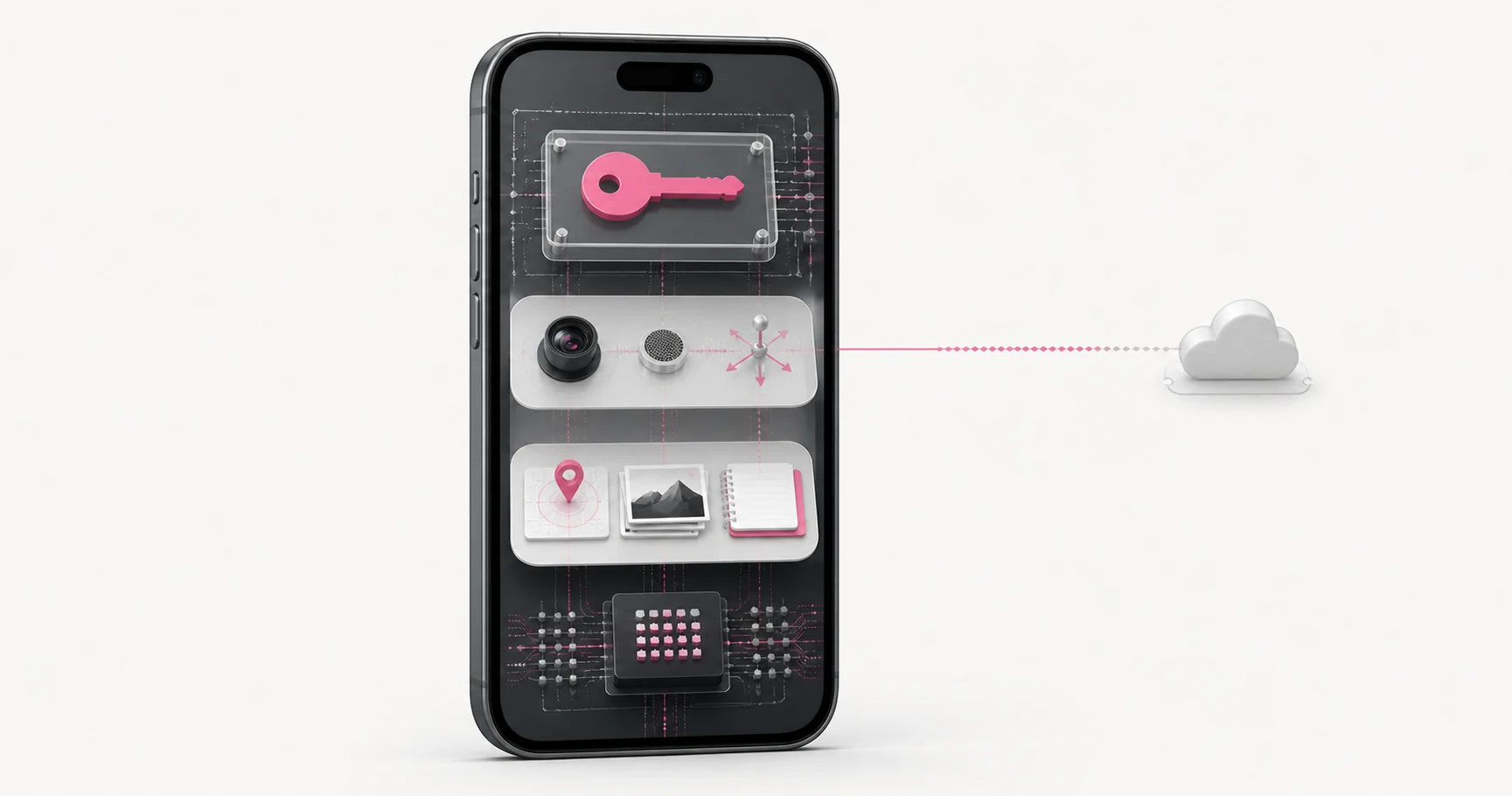
Every thirty seconds, an authenticator app performs a small piece of edge computing. It combines a secret with the current time, calculates a short-lived answer, and shows the result. The useful work happens in a device already under the person’s control.
The underlying TOTP standard is not machine learning, and a six-digit code is hardly an impressive workload for a modern phone. But the architecture is worth noticing. We already understand that a pocket-sized device can hold sensitive state, perform a bounded computation at the moment it is needed, and participate in a larger system without behaving like a passive screen for a remote server.
Passkeys make the pattern stronger. A device can create and protect a private key, then prove possession without sending that private key to the service. On Apple platforms, apps can also protect eligible keys with the Secure Enclave, a hardware-based key manager isolated from the main processor.
Machine learning makes the same architectural instinct much more interesting.
The phone is not only a smaller server
“Edge computing” can sound like an infrastructure diagram: a large cloud in the middle, with smaller boxes pushed closer to the user. That description is technically reasonable and productively incomplete.
A phone is not valuable merely because it is nearby compute. It is valuable because it sits beside the context.
It has a camera, microphones, motion sensors, radios, a clock, location when permitted, files and app data within sandbox boundaries, and secure hardware tied to the person holding it. It is present when a thought is spoken, a receipt is photographed, a golf swing happens, a contact is exchanged, or an unfamiliar object appears in view.
None of that context is automatically available to every app, nor should it be. Permissions, sandboxes, purpose, and user intent still decide what software may touch. But when access is appropriate, local computation can meet the data where it already lives.
The interesting shift is not that a phone can call an AI service. It is that useful intelligence can run beside the moment that produced the data.
Machine learning changes the size of the local answer
Phones have been running machine-learning models for years: detecting faces, transcribing speech, classifying images, improving photographs, recognizing sounds, predicting text, and interpreting motion. These systems often produce a small, useful answer from a much richer input.
Frameworks such as Core ML can use the CPU, GPU, and Neural Engine for on-device prediction and even some device-local adaptation. On Android, Google now positions Gemini Nano and ML Kit’s generative AI APIs for local text, image, and audio tasks alongside traditional tools such as ML Kit, MediaPipe, and LiteRT.
The newer change is that the local answer no longer has to be only a label or a score. On supported devices, foundation models can summarize, extract structured information, refine text, interpret an image, call a constrained tool, or produce an embedding that makes personal information searchable by meaning. Apple’s Foundation Models framework, for example, exposes an on-device language model for tasks including summarization, entity extraction, structured generation, image understanding, and tool calling.
This does not turn a phone into an unlimited reasoning machine. It does expand what a product can complete locally before it needs to ask a server for help.
Local inference changes more than privacy
Privacy is the obvious advantage. If an app can classify a photograph, transcribe a note, rank personal results, or extract fields without uploading the input, it can avoid creating another copy of sensitive material somewhere else.
But local inference changes several other product constraints at the same time:
- Latency: there is no network round trip before the interface can react.
- Availability: a useful path can continue in a parking garage, on an airplane, or during an outage.
- Marginal cost: repeated inference uses hardware the customer already owns instead of adding a server bill for every interaction.
- Personalization: the product can adapt to local history without first constructing a centralized behavioral profile.
- Data minimization: a system can send a bounded result—or nothing at all—instead of exporting the raw context that produced it.
These advantages reinforce each other. A feature that works offline also tends to feel immediate. A feature with no per-request cloud cost can be used more freely. A feature that processes personal context locally can be more specific without requiring the company behind it to accumulate the same context.
An app can run a model on device and still log the input, sync the output, collect behavior, or request permissions it does not need. The privacy boundary comes from the entire data path, not the location of one model invocation.
The edge is not a miniature cloud
The fastest way to build a disappointing on-device feature is to begin with a cloud workflow and insist that a smaller model imitate all of it.
A phone has real limits. Memory is shared with the rest of the system. Sustained computation consumes battery and creates heat. Model availability differs by hardware, operating-system version, language, and region. Context windows are smaller. Background execution is constrained. A task that looks inexpensive on a workstation may be hostile to a device that also needs to remain a phone.
The better question is not, Can the phone run our cloud feature? It is, What is the smallest useful decision the phone can make here?
That changes model and interface design. A local system may extract three fields rather than converse indefinitely. It may rank ten candidate actions instead of generating an entire plan. It may detect that a voice note is about a customer and prepare a draft label, while leaving the person to confirm it. It may use a deterministic parser before invoking a model at all.
Smaller models become especially useful when the product supplies the structure. Constrained output, explicit tools, local retrieval, narrow prompts, and ordinary code can do more for reliability than asking the model to improvise the whole experience.
The new product surface is private context
Cloud models are powerful partly because they contain broad knowledge and can spend far more compute on a request. Phones are becoming powerful in a different way: they can work with context that would be awkward, slow, expensive, or inappropriate to centralize.
That opens several categories of product:
- Private extraction: turn a receipt, form, voicemail, screenshot, or note into structured data without making the source document a server asset.
- Situational interfaces: respond to motion, audio, images, nearby devices, or location at the moment an action becomes useful.
- Personal retrieval: search and rank a private corpus using local embeddings and rules rather than uploading the corpus to make it searchable.
- Adaptive assistance: learn lightweight preferences or recurring patterns without converting every interaction into centralized training data.
- Constrained agents: let a model choose among approved local tools while the operating system, the app, and the person retain authority over the actual action.
The last category needs particular restraint. A model generating a suggestion is not the same as software being authorized to act. Local execution does not remove the need for confirmation, reversible operations, access control, auditability, or clear failure states. It simply gives us a better place to evaluate some of the context before asking for that authority.
A good hybrid architecture should be asymmetric
There is no prize for keeping every computation on the phone. Larger cloud models remain better for long documents, broad external knowledge, heavy reasoning, and workloads that exceed the device’s memory or energy budget. Apple’s own current guidance draws this line: start by evaluating the on-device model, then use server-side intelligence when the feature needs a larger context or stronger reasoning.
The architectural mistake is treating local and cloud inference as interchangeable endpoints behind a routing flag. They carry different costs and different trust consequences.
A thoughtful hybrid product can be asymmetric:
- Use deterministic code when the rule is known.
- Use a small local model when the task depends on private or immediate context.
- Escalate to a remote model only when the added capability changes the outcome enough to justify the transfer.
- Send the minimum useful context rather than the easiest available payload.
- Keep a useful local path when connectivity, eligibility, cost, or consent blocks the remote one.
This is less dramatic than putting a chatbot in every screen. It is also closer to how good software has always been designed: choose the smallest mechanism that can do the job reliably, and make the boundary visible when the mechanism changes.
What this means for KWIP
We keep finding versions of this idea across the products we build.
Smarter Golf Swings interprets motion on the Watch without pretending that wrist sensors measured ball flight. Kwip Contacts uses the device as the owner of contextual cards and shared snapshots rather than turning a personal identity into a hosted profile. Kwip Atlas reconstructs context around intentional clipboard events without recording every screen or keystroke.
These are different products, and not every one needs a foundation model. The common architecture is more important than the label: the customer’s device is a capable environment in its own right, not merely a remote control for infrastructure we own.
That is the part of mobile machine learning that feels newly exciting. More intelligence can happen near the person, using context the product has legitimately earned, while the company behind the software has less reason to possess that context at all.
The phone is becoming useful not because it can send everything to a model, but because increasingly it does not have to.