
The obvious way to reconstruct someone’s work is to record everything. Watch the foreground window. Save the browser history. Capture the screen. Keep enough activity and the gaps begin to disappear.
It also creates a different product.
Kwip Atlas started with a smaller observation: the things people intentionally copy already form a useful trail. A command from a terminal. A paragraph from documentation. A link opened during research. A file path. An image. A color. These artifacts are incomplete, but they are rarely random. They are the material a person selected because it mattered to the work in front of them.
That gave us a choice. We could treat missing context as a defect and collect more activity until the timeline looked complete. Or we could treat restraint as part of the product and see how much context intentional artifacts could recover on their own.
We chose the second path.
The event boundary is the product boundary
By default, Atlas observes the general Mac pasteboard conservatively. When something is copied, it can retain the artifact’s content and type, its timestamp, a local hash and embedding, and the application that was in front at that moment.
It does not record keystrokes. It does not run a continuous foreground-window log. It does not capture screens, camera input, microphone audio, full browser history, idle time, or a remotely silent employee-telemetry stream. The global Recall shortcut uses the system hot-key API without asking for Accessibility or Input Monitoring permission.
This is not a claim that clipboard content is harmless. A copied artifact can be deeply sensitive. Atlas filters concealed, transient, sensitive, and excluded content before persistence or embedding; password managers are excluded by default. Retained content is encrypted locally with Keychain-backed keys. Pause, retention, exclusions, export, and deletion are product controls rather than paid privileges.
An intentional copy, its type and time, a local representation for retrieval, and limited provenance from the moment of capture—not a continuous account of what the person did.
The boundary costs us information. Atlas can see that a person copied an error from Xcode, then a paragraph from Safari, then a command from Terminal. It cannot claim to know everything that happened between those actions. Sometimes that means the correct result is a visible gap or an unassigned artifact instead of a polished story.
That is not the product failing to sound confident enough. It is the product refusing to invent evidence.
From artifacts to episodes
A clipboard manager usually answers an item question: What did I copy? Atlas is trying to answer a context question: What was I doing around the thing I remember?
The difference is reconstruction.
Atlas classifies text, links, files, images, colors, code, and other supported artifacts. It can extract a bounded set of useful children—such as links inside a large block of text or dominant colors inside an image—without discarding the parent artifact. Literal search handles exact fragments. Local sentence embeddings make conceptual retrieval possible when the wording is gone but the meaning remains.
Time, semantic affinity, source transitions, duplicates, nested references, and known lineage provide evidence that several artifacts belong together. Conservative combinations can become a work episode: an editable reconstruction with chronology, confidence, and a useful next action.
The hierarchy matters:
clipboard event → topic chapter → work episode → project threadChronology remains structural. Semantic similarity can enrich time, but it does not get to erase it. A plant-research link and a database command may be mathematically close for an interesting reason; that does not mean Atlas should quietly rewrite the afternoon.
Observed facts, derived properties, and inferred groupings remain distinct. Inferred titles say “Likely.” Boundaries carry confidence. The interface exposes why items were grouped. A person can split, merge, rename, remove, or manually assign what the system got wrong.
The model gets a vote. The person gets the final edit.
Why not add activity monitoring as an optional mode?
Because “optional” collection still changes the center of the product.
Once continuous activity exists, completeness becomes the expectation. Missing time looks like broken instrumentation. More permissions become reasonable. The data model, support surface, security responsibility, enterprise sales story, and eventually the customer all begin moving toward monitoring.
That may be appropriate for other products. It is not neutral infrastructure inside this one.
Atlas is a memory instrument, not a productivity judge. Its useful outcome is not time spent, applications opened, clips accumulated, or graph nodes created. The useful outcome is that someone finds an earlier episode and then reuses an artifact, reopens a source, exports a reconstruction, or simply gets enough context back to continue.
A more complete surveillance record could produce a more complete timeline. It would also make the timeline serve a different incentive.
Privacy constraints can improve the interface
There is a familiar way to present privacy: write a policy, place a lock icon near a settings screen, and keep the actual system invisible.
We wanted the boundary to show up in ordinary use instead.
- The menu bar says whether Atlas is remembering or paused.
- Timed pauses and source exclusions are immediately available.
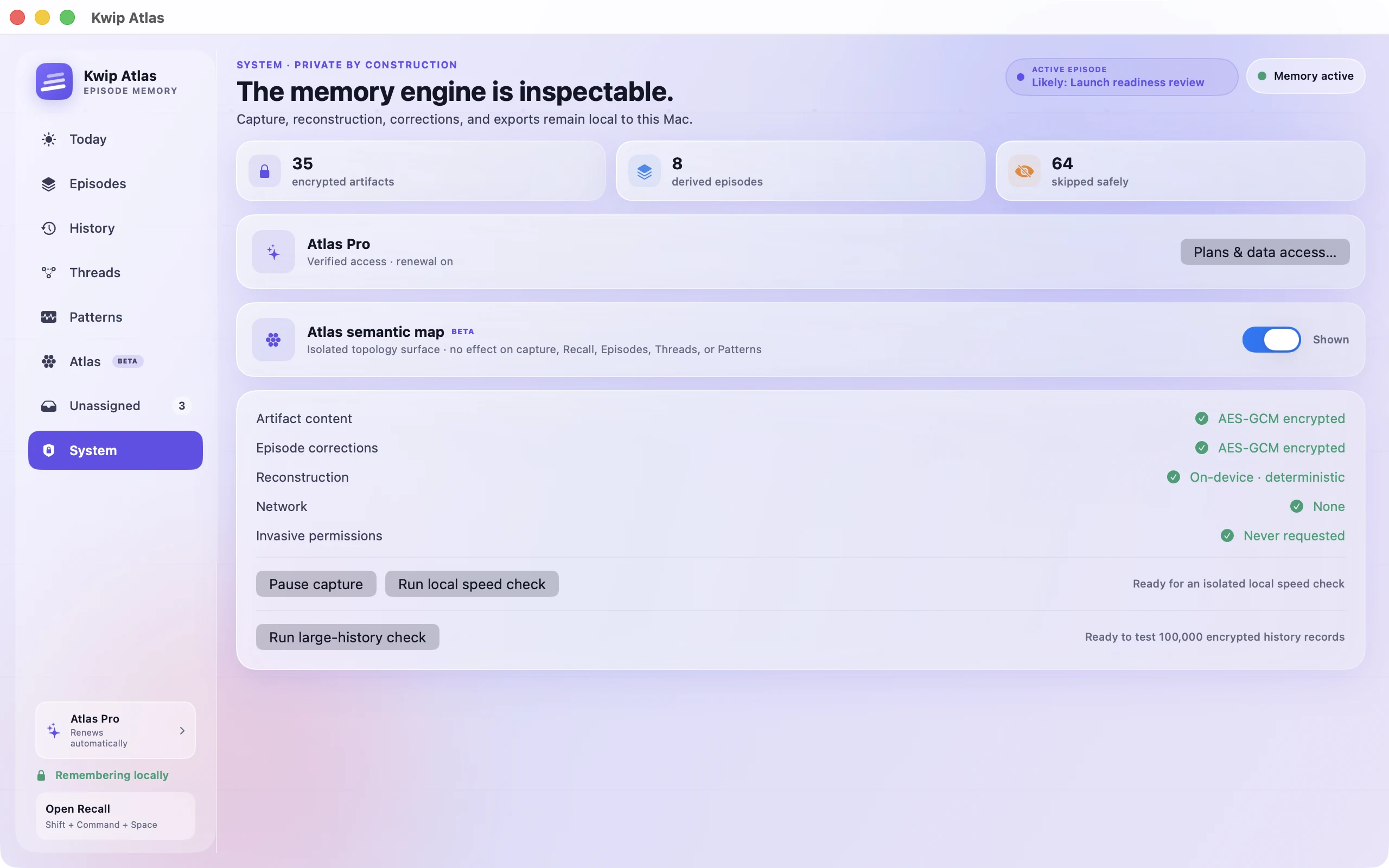
- The System view shows encrypted artifacts, skipped items, local reconstruction, and the absence of a network dependency.
- The Privacy Ledger records content-free counts and skip reasons locally without retaining queries, clipboard content, paths, URLs, embeddings, or inferred topics as analytics.
- Unassigned items and evidence gaps stay visible rather than being forced into confident-looking episodes.
Those choices do more than communicate trust. They make the reconstruction easier to reason about. If Atlas cannot show why it grouped something, the grouping is less useful. If a person cannot correct the inference, the system is not helping them remember; it is replacing their account with its own.
The narrower system still has to earn its place
A principled boundary does not automatically make a good product. Clipboard artifacts may be too sparse in some kinds of work. Semantic grouping may join items that only look related. A local corpus can become large enough that an initially simple exact search strategy needs to evolve. Privacy is not an excuse for weak retrieval.
Those are product questions we can measure without collecting the contents of someone’s work. Does Recall return quickly? Are high-confidence joins correct? Do people correct the same kinds of boundaries? Does a recovered episode lead to a real next action? Do users come back on another day because Atlas restored something they otherwise would have rebuilt?
The most interesting version of Atlas is not the one that knows everything. It is the one that can admit what it does not know, recover enough of the path to be useful, and then get out of the way.
We are not trying to build the most complete record of a person’s activity. We are trying to recover the smallest useful trail around the work they intentionally touched.
That is a harder constraint than “record more.” It is also, so far, a much more enjoyable product to build.